

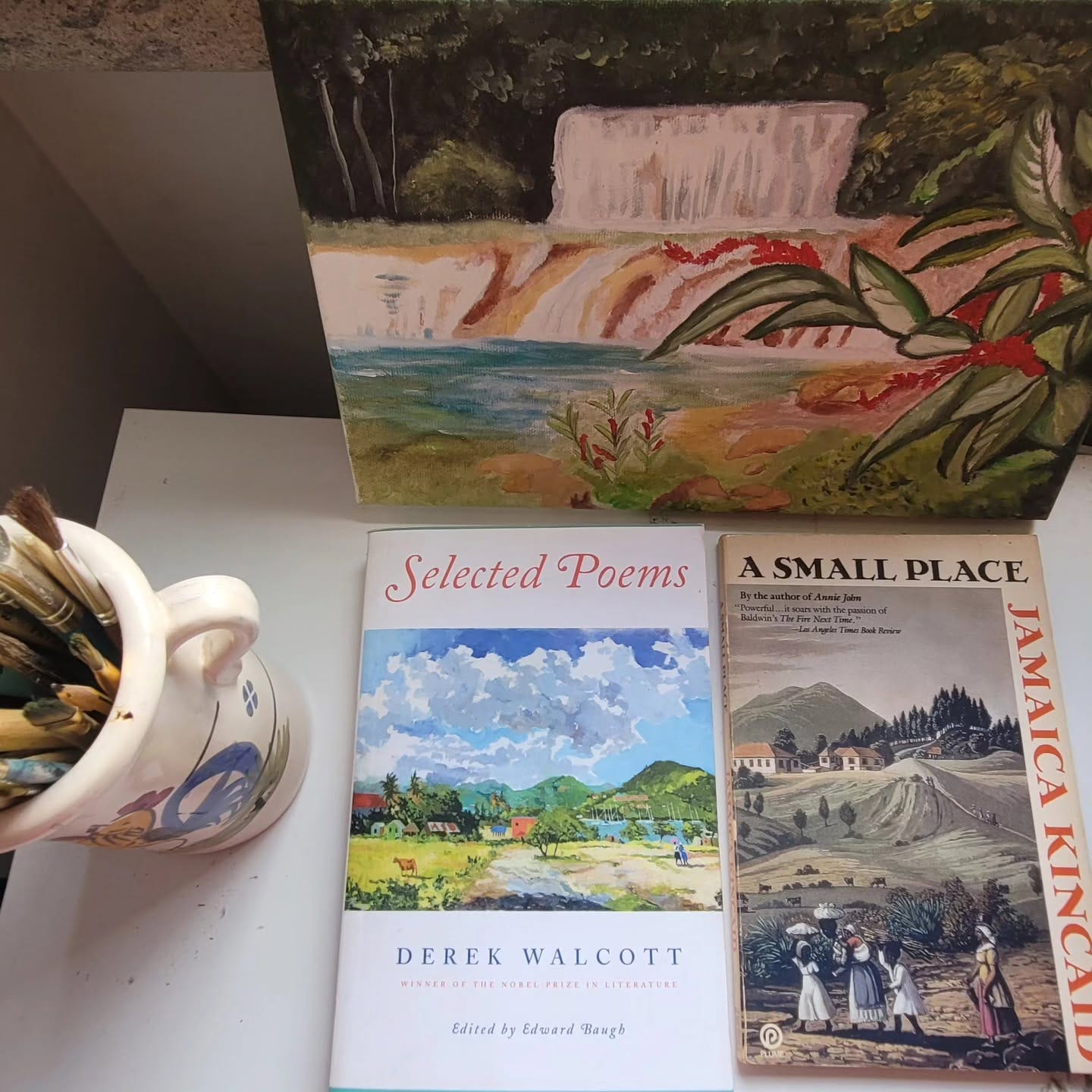
June has been designated Caribbean Reader Month, which celebrates writers and stories from the Caribbean. I have been collecting Caribbean literature since it was a mandatory subject in my high school in Jamaica and part of our Caribbean Exams, which replaced the British O-level exams. One of my favorite poets is Derek Walcott. When I started reading his poetry, I found similarities in his love for his country, Saint Lucia, and the Caribbean, his love of the sea, his work as a painter, and my new passion, Greek mythology. I even modeled the cover of my book, The Colour Wheel of My Dreams, after his Selected Poems, which features one of his paintings on the cover. So it is only fitting that he is my chosen author and poet for June.
When the Caribbean writer Derek Walcott received the Nobel Prize in Literature in 1992, the world finally recognized what readers throughout the Caribbean had long known: that one of the greatest poets writing in English came not from London, New York, or Paris, but from a small island in the Eastern Caribbean.
Born on the island of Saint Lucia in 1930, Walcott spent his life exploring questions of identity, colonialism, history, memory, and belonging. His poetry moves effortlessly between the Caribbean and Europe, between fishermen and ancient heroes, between the blue waters of the Caribbean Sea and the classical myths of Ancient Greece.
Walcott once described himself as “a divided child,” a phrase that captures his mixed heritage and much of his work. He inherited African, European, and Caribbean influences simultaneously. Rather than choosing one identity over another, he transformed this cultural complexity into poetry that reshaped world literature.
What Are Derek Walcott’s Poems About?
What drew me to Derek’s poetry is that at the heart of his poetry is the search for home. His poetry often traveled between the Caribbean and Europe, examining identity, memory, and the legacy of place. In The Colour Wheel of My Dreams, I embark on a similar journey, from Jamaica to Italy and discover how distance deepens one’s connection to home. Like Walcott, I find inspiration in the landscapes, languages, and contradictions of two worlds, using poetry to bridge the sea between them. And here is the connection to the sea again, which is one of the themes for this newsletter.
His poems often examine what it means to belong to a region shaped by colonization, slavery, migration, and cultural mixing. The Caribbean, in Walcott’s view, is not merely a collection of islands but a place where many histories collide.
Several themes appear repeatedly in his work:
The Sea: The Caribbean Sea serves as both a physical and symbolic presence. It represents memory, history, loss, and connection.
Colonialism: Walcott explores how European empires shaped Caribbean societies while questioning how Caribbean people can reclaim their own narratives.
Identity: Many poems reflect the tension of being both Caribbean and heir to European literary traditions.
Nature: The landscapes of Saint Lucia—its mountains, fishing villages, forests, and coastlines—are vividly portrayed throughout his work.
Art and Memory: Walcott frequently reflects on the role of poetry, painting, and storytelling in preserving culture.
His language combines lyrical beauty with intellectual depth, allowing readers to experience both the physical world and the historical forces beneath it.
Greek Mythology in Walcott’s Poetry
One of the most remarkable aspects of Walcott’s work is his use of Greek mythology. Some critics initially questioned why a Caribbean poet would draw so heavily on Homer and the classical world. Walcott’s answer was simple: the classics belong to everyone. I love this! By placing classical figures in a Caribbean setting, Walcott suggests that the struggles of Caribbean people are equally worthy of epic treatment. Walcott’s answer is that mythology can be reinvented. Ancient Greece and the Caribbean become part of a shared human story.
Walcott’s Relationship with the Caribbean
Although Walcott traveled widely and taught abroad, Saint Lucia remained the emotional center of his work. The island appears repeatedly in his poetry as a place of beauty, memory, and inspiration. One can never fully leave the Caribbean if one is born to it.
In the famous poem The Sea Is History ( Selected Poems, pg. 137), Walcott challenges traditional versions of history and argues that the history of Caribbean people is carried in the sea itself—the sea that witnessed slavery, migration, and survival.
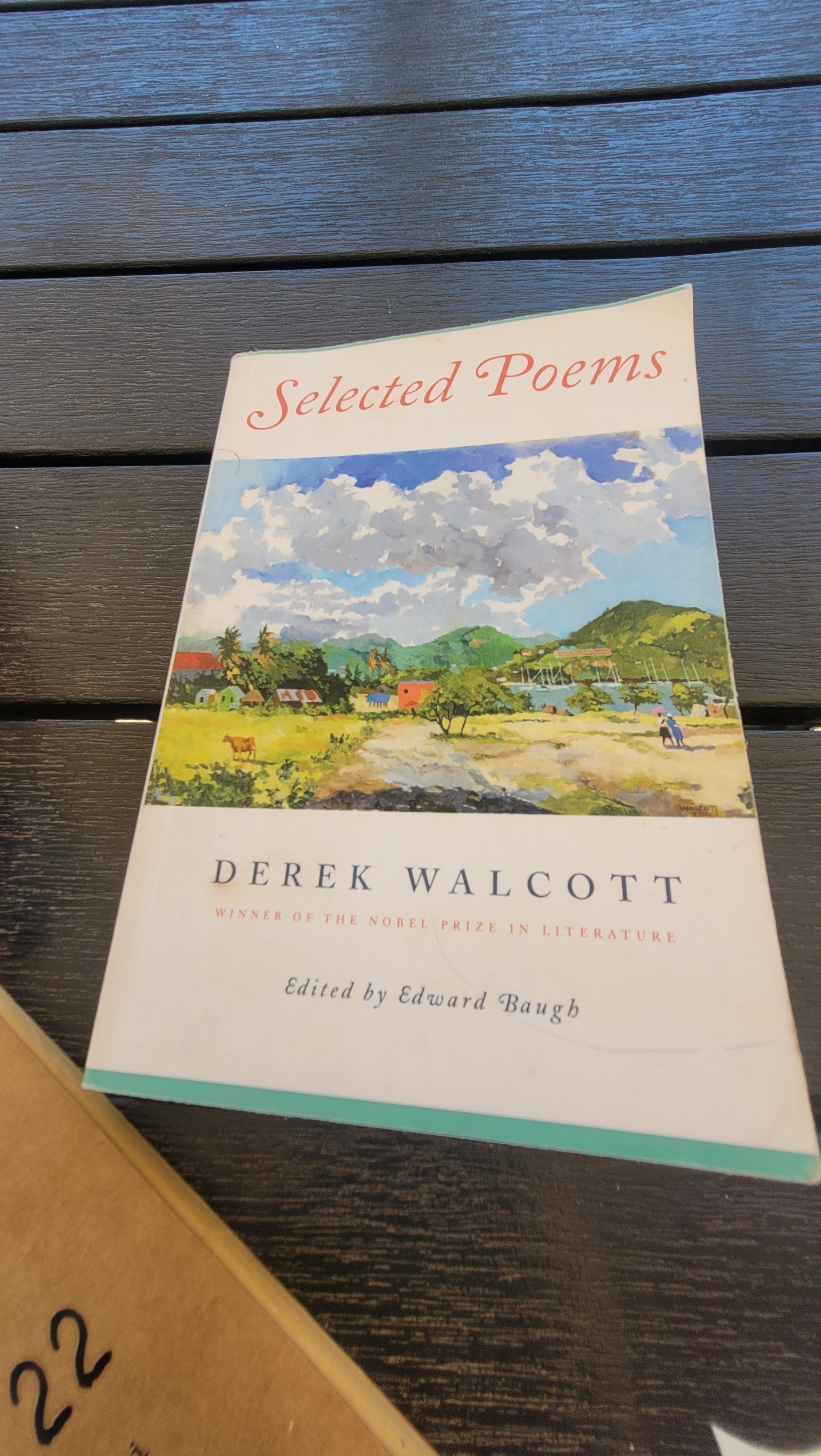
Another beloved poem, A Far Cry from Africa ( Selected Poems page 6), explores the tensions of mixed heritage. Although focused on Africa and colonial violence, it also reflects the larger Caribbean experience of cultural fragmentation.
Perhaps no poem captures his love of home more beautifully than Love After Love. While often read as a personal poem about self-discovery, it reflects a broader Caribbean theme of reclaiming one’s identity after centuries of cultural displacement.
His descriptions of Saint Lucia are rich with sensory detail:
Breadfruit trees
Fishing boats
Tropical light
Market streets
Mountain landscapes
The rhythm of island life
For Walcott, the Caribbean was not peripheral to world culture. It was central.
Walcott’s Relationship with Europe
Walcott’s relationship with Europe was complex.
As a student of English literature, he admired writers such as William Shakespeare, John Milton, and James Joyce. He was deeply influenced by European artistic traditions and classical literature.
Yet he also understood that these traditions arrived in the Caribbean through colonialism.
This tension appears throughout his poetry.
In A Far Cry from Africa, Walcott famously wrestles with divided loyalties:
“How choose
Between this Africa and the English tongue I love?”
These lines reveal the paradox at the center of his work. English was the language of empire, yet it was also the language through which he created poetry.
Rather than rejecting Europe entirely, Walcott sought dialogue. He believed Caribbean writers could inherit European literary traditions while reshaping them to tell Caribbean stories.
His work suggests that cultural identity does not require purity. Instead, it can emerge from mixture, adaptation, and transformation.
Poems That Explore Home
Several poems vividly celebrate the Caribbean as home:
The Sea Is History
This poem reclaims Caribbean history from colonial narratives and locates memory within the sea itself.
Names
Walcott examines the significance of naming places and people in a region shaped by colonization.
Ruins of a Great House
Although focused on a colonial estate, the poem reflects on Caribbean landscapes and the legacy of empire.
Omeros
The entire epic serves as a meditation on Saint Lucia, its people, and its history.
A Poet of Two Worlds
Derek Walcott’s greatest achievement was showing that Caribbean stories belong among the world’s great literary traditions. He refused to choose between Saint Lucia and Europe, between local experience and classical myth, between the fisherman and the epic hero. Instead, he brought these worlds together. Through poems such as Omeros, The Sea Is History, and A Far Cry from Africa, Walcott demonstrated that the Caribbean is not a footnote to history but a place where history, mythology, and culture continually reinvent themselves.
As I read more about Derek, I realized that his time in Italy also influenced his poetry. He wove Italy into his poetry by drawing inspiration from its artistic traditions, classical past, and Mediterranean landscapes. As he traveled through Italy, he reflected on the connections between Europe and the Caribbean, often comparing ancient civilizations and Renaissance art with the culture and beauty of Saint Lucia. In works such as The Prodigal, Italian cities and landscapes become places of reflection, where the poet compares the beauty and history of Europe with the vibrant life of his Caribbean homeland. For Walcott, Italy was not a replacement for Saint Lucia but another lens through which he explored memory, identity, and the meaning of home.
Reading more of Derek’s work as inspired me to update my book of poems. In my work I can extend a Caribbean literary tradition that Walcott helped establish: exploring how migration transforms one's understanding of home, identity, and belonging.
His poetry reminds us that home is not always a fixed place. Sometimes it exists in the space between worlds, where memory, language, and imagination meet. For Walcott, that space was the Caribbean Sea itself—vast, complex, and endlessly inspiring. If you do get a copy of one of Derek Walcott’s books, let me know.
Happy reading.
Primary Sources by Derek Walcott
Collected Poems, 1948–1984
Walcott, D. (1986). Collected Poems, 1948–1984. New York: Farrar, Straus and Giroux.
This collection contains many of his most studied poems, including:
“A Far Cry from Africa”
“The Sea Is History”
“Love After Love”
“Ruins of a Great House”
“Names”
“Sea Grapes”
Selections from The Fortunate Traveller
Selections from Midsummer
Omeros
Walcott, D. (1990). Omeros. New York: Farrar, Straus and Giroux.
Recommended Editions for Readers
If you’re introducing readers to Walcott, I would recommend beginning with:
Selected Poems (for accessibility)
Collected Poems, 1948–1984 (for the major poems)
Omeros (for his masterpiece)